A fascinating man - Ed Wilson is the ant man.
Over six decades at Harvard University he has discovered more about ants than anyone else in history. He has thrown into relief for the general public just how important ants are—how they represent 25% or more of the insect biomass on the planet, how collectively they weigh more than all the humans in the world, how they assist humans by aerating the soil, suturing wounds, or, as in South Africa, harvesting the rooibos seeds for farm workers to collect. And how ancient they are: in 1966 Wilson and his colleagues identified an ant in a shard of amber that was 80m years old. Ants emerged along with flowering plants 130m years ago. By contrast, the genus Homo diverged 2m years ago, has existed as Homo sapiens for a fraction of that time, with a civilization of 20,000 years or so.
Read more: Ants and Us, Published on More Intelligent Life
or watch NOVA: Lord of the Ants on YouTube
Tampilkan postingan dengan label insects. Tampilkan semua postingan
Tampilkan postingan dengan label insects. Tampilkan semua postingan
Kamis, 30 Desember 2010

Selasa, 23 November 2010
New large pink moth discovered in Arizona
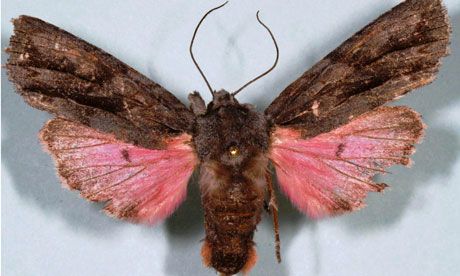 The mountains of southeastern Arizona have been a favorite collecting site for lepidopterists for generations. Yet new species continue to be described at the rate of about three per year.
One of the latest discoveries is the largest member of the genus Lithophane, a group of particularly large and beautifully coloured moths. Lithophane leeae has a forewing length 25% larger than the previous record, measuring 25mm, and more extensive and brighter pink coloration. So far known from a single female collected at 7,700ft elevation in mid-June in the Chiricahua Mountains, this species is predicted to feed on pine, like related species.
Source
Senin, 19 Juli 2010
Mud-Puddling Pale Tiger Swallowtail Butterflies
 From April through late-July you can find Pale Tiger Swallowtail Butterflies in British Columbia. I see them most often flittering around our cabin on Powell Lake in June and July. They are an impressive, large butterfly with a pale yellow background and heavy black "tiger" stripes. They like hilly woodlands near streams and water. Powell Lake fits that perfectly.
 The larvae of the Pale Tiger Swallowtail eat foliage of woody plants then turn into pupa to wait out the winter. Butterflies emerge in the spring to enjoy the sweet nectar of blooming flowers, and start the mating and egg laying cycle all over again.
The males have an interesting behaviour called mud-puddling. They use small puddles and muddy ground to get moisture and nutrients from the damp soil. Recently, I found two butterflies in my garden doing just that. Here's a short video of their dance-like endeavour.
When I took the video I didn't know the purpose of their activity. Now, with a little research I've learned something new about the world around me. Have you learned something new lately? -- Margy
Senin, 23 November 2009
Slimy Visitor
Right now there's lots of moss, sticks, leaves and other debris lying on the forest floor. That's called duff. I found this slimy visitor taking advantage of this buffet of blow down.
 I know he's a mollusk, but insect was the closest blog category I have. The Black Slug (Arion rufus) is from Europe, but was introduced into British Columbia in 1941 and has been considered a serious pest since 1962. They can grow up to 18 cm, pretty big for the slug world.
My guy was hiding his front tentacles (eyes and sensory organs), but you can see his characteristic black colour and tubercles (rough projections) on his back. They have the distinction of being hermaphroditic and can self-fertilize. This makes reproduction quick and easy. They start at about three months and lay about 150 small round eggs at a time. During their 1-2 year lifespan, they can produce a tremendous amount of offspring, and so on, and so on, if you get my drift. That is one of the reasons they are such a tremendous pest.
I haven't found any in my garden, only up on the cliff. They typically feast on feces, dead animals, fungi, algae, lichens and decomposing plant matter. That sounds pretty good, but they also enjoy ingesting live plants and can dramatically alter the ecosystem. Eradication is near impossible, with mechanical removal the most successful method. That may work in a small garden, but not in the open forest. I guess that means they are here to stay. -- Margy
 I know he's a mollusk, but insect was the closest blog category I have. The Black Slug (Arion rufus) is from Europe, but was introduced into British Columbia in 1941 and has been considered a serious pest since 1962. They can grow up to 18 cm, pretty big for the slug world.
My guy was hiding his front tentacles (eyes and sensory organs), but you can see his characteristic black colour and tubercles (rough projections) on his back. They have the distinction of being hermaphroditic and can self-fertilize. This makes reproduction quick and easy. They start at about three months and lay about 150 small round eggs at a time. During their 1-2 year lifespan, they can produce a tremendous amount of offspring, and so on, and so on, if you get my drift. That is one of the reasons they are such a tremendous pest.
I haven't found any in my garden, only up on the cliff. They typically feast on feces, dead animals, fungi, algae, lichens and decomposing plant matter. That sounds pretty good, but they also enjoy ingesting live plants and can dramatically alter the ecosystem. Eradication is near impossible, with mechanical removal the most successful method. That may work in a small garden, but not in the open forest. I guess that means they are here to stay. -- Margy
Sabtu, 17 Oktober 2009
Obtuse Sawyer
 If you take the time to look, there are discoveries everywhere. Last year on Peter's deck I saw a beetle with very long antennae. From the Insects of the Pacific Northwest guide, I think it was an Obtuse Sawyer (Family Cerambycidae). It is a long-horned beetle well known for wood boring. Trees around here hardly have a chance, the Western Conifer Seed Bugs destroy the cones and the wood borers destroy the trees.
Eggs are laid on the bark and the larvae do the boring damage. Fortunately, most species prefer weakened, dying or freshly cut logs. The Obtuse Sawyer (Monochamus obtusus) is one of these.
 If you want to see some excellent insect pictures, head on over to Wanderin Weeta's site. Susannah is from Delta BC and she takes pictures throughout the lower mainland. I especially love her closeups! -- Margy
Jumat, 16 Oktober 2009
Western Conifer Seed Bugs
 Down at John's there are two types of insects that are plentiful. The first is wasps (not hornets thank goodness) and the other is what he calls Stink Bugs. When I saw one crawling on our screen door, I took some pictures and looked it up. They are called Western Conifer Seed Bugs (Deptoglossus occidentalis). I used my Insects of the Pacific Northwest by Peter and Judy Haggard to make the identification.
 The photograph in the book and the bug were an exact match. They are brown and have a distinctive white (or yellow) zigzag line through the middle of their body and hind legs that look somewhat like a flattened leaf. Both the nymph and adult eat conifer cones. I guess that's better than attacking the trees, but it can't be that good for future forest growth. The book says they are rarely seen because they spend most of their life up high in the trees, but these bugs seem to be enjoying their float cabin fall vacation.
 I really enjoy having nature guides at the cabin so I can identify the plants, animals and rocks I encounter. I especially like ones with photographs rather than line drawings. Do you have any favourite nature guides that you recommend? -- Margy
Senin, 22 Juni 2009
Ouch! That Stings!
 Yesterday I shared information about hornets nesting near our cabin. When our friends John and Mr. Hat came to visit, Mr. Hat got stung by a hornet. Hornets are very aggressive in defending their nest. Mr. Hat learned that the hard way. The stinger is a modified ovipositor and, unlike bees, wasps and hornets can sting multiple times. When we got back to the cabin I got out The Doctors Book of Home Remedies to see what was the best course of action.
Mr. Hat (and I) were a little worried that there might be a bad reaction, but fortunately it was mild. The venom injected causes sharp, instantaneous burning pain followed by continued pain, redness, swelling and itching. In normal situations, the discomfort can last from hours to a day.
What did the book suggest?
- Don't get stung. Easier said than done. Wear white, don't wear perfume, take zinc, oil your skin and/or run for shelter or water.
- Don't smash the wasp or hornet. If the venom sack is broken it releases a chemical that incites the others to attack.
- Wash the site with soap and water.
- Use ice to reduce swelling.
- Apply an antiseptic.
- If you are not allergic to aspirin, moisten the skin and rub a tablet over the site to neutralize the venom.
- Apply heat or use a hair dryer over the site.
- Apply household ammonia (also available as commercial towelettes for stings).
- Use a paste made from baking soda and water.
- As strange as it sounds, apply meat tenderizer.
- If nothing else is available, apply mud and let it dry.
Keep your eyes and ears open this time of year. Prevention is worth a pound of cure. -- Margy
Stirring up a Hornet's Nest
 Well, hopefully not! This time of year bald-faced hornets start making nests. Dolichovespula maculata is actually a member of the paper wasp family commonly found in North America. In Insects of the Pacific Northwest (Haggard & Haggard) they are described as social vespids.
If you can get close enough with getting stung, you will see their dark bodies with white face markings. They can also be identified by the way they fold their wings longitudinally over their abdomen while at rest. Plus, they have the distinguishing narrow (wasp) waist between the thorax and abdomen.
 Nests are built in spring by new workers born from females mated the previous year. The first offspring are sterile female workers who chew wood into pulp to form a nest, sometimes reaching up to three feet in length. That sounds just about right for a hornet from a paper mill town like Powell River.
 When I first saw the hornets there were two small half dome structures under a niche in our rock wall. After a few days, they were both incorporated into a larger nest with one opening at the lower end. Last year a nest was started under our cabin eves. I could watch them build it up layer by layer until our good friend John volunteered to knock it off for us. You can use wasp spray to kill them first, but if you wait until the cool of night they become somewhat dormant and the nest can be knocked off with only a little danger of getting stung. Unfortunately (for us that is) the rock wall nitch is in a place that we can't reach. We'll just have to more careful while swimming in our natural pool.
 More sterile female workers are born throughout the early summer to tend the queen and feed the larvae. In late summer, reproductive males and females emerge to mate so the cycle can continue. In fall, after the first frost, all members of the colony die except for the newly mated females. They live through the winter to start new colonies in the spring. Maybe then we can remove the nest and maybe preserve it. Click here for some directions. But I think I'll forget about the relocation procedures. -- Margy
Rabu, 27 Mei 2009
Pale Tiger Swallowtail
On Monday, I went out to see how my potatoes in a barrel were doing. I buried the green sprouts a week ago and wanted to see how many had resurfaced. Right there is the barrel was the most beautiful butterfly.
 It was a Pale Tiger Swallowtail. Hopefully it wasn't laying eggs so that its large green larva could devour my potato plants. I'll have to keep an eye out for that, but it's young are supposed to like the foliage of woody plants.
 I have lots of books and guides about nature up at the cabin. One I really like for insects is Insects of the Pacific Northwest by Peter and Judy Haggard. The photographs make identifications much easier than illustrations. A good reference website is BugGuide.Net. It includes "insects, spiders and their kin" from the US and Canada. There's even an active forum where you can connect with other bug lovers or get assistance with a tricky identification. -- Margy
 It was a Pale Tiger Swallowtail. Hopefully it wasn't laying eggs so that its large green larva could devour my potato plants. I'll have to keep an eye out for that, but it's young are supposed to like the foliage of woody plants.I have lots of books and guides about nature up at the cabin. One I really like for insects is Insects of the Pacific Northwest by Peter and Judy Haggard. The photographs make identifications much easier than illustrations. A good reference website is BugGuide.Net. It includes "insects, spiders and their kin" from the US and Canada. There's even an active forum where you can connect with other bug lovers or get assistance with a tricky identification. -- Margy
Selasa, 12 Mei 2009
Blossoms and Bumble Bees
Spring brings beautiful blossoms, both natural and from the nursery.
 No matter which, bumble bees love to suck the nector from within.
 Last year, they took up residence in my daffodils.
 This year my pansies are a favourite. Don't you just love Spring? - Margy
 No matter which, bumble bees love to suck the nector from within.
 Last year, they took up residence in my daffodils.
 This year my pansies are a favourite. Don't you just love Spring? - Margy
Jumat, 01 Mei 2009
International Garden Photographer of the Year
The finalists of the UK's International Garden Photographer of the Year award have just been announced.
 Garden tiger moth close-up by Paul Keene
This picture of a garden tiger moth (Arctia caja) was taken in Amersham, Buckinghamshire. The caterpillars of this moth feed on nettles, so if you want these moths to be a feature in your garden, then keep a rough, uncultivated patch
(via Look at This)
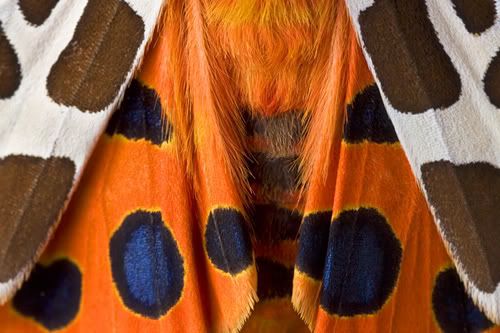 Garden tiger moth close-up by Paul Keene
This picture of a garden tiger moth (Arctia caja) was taken in Amersham, Buckinghamshire. The caterpillars of this moth feed on nettles, so if you want these moths to be a feature in your garden, then keep a rough, uncultivated patch
(via Look at This)
Senin, 20 April 2009
Cute or not? jumping spider
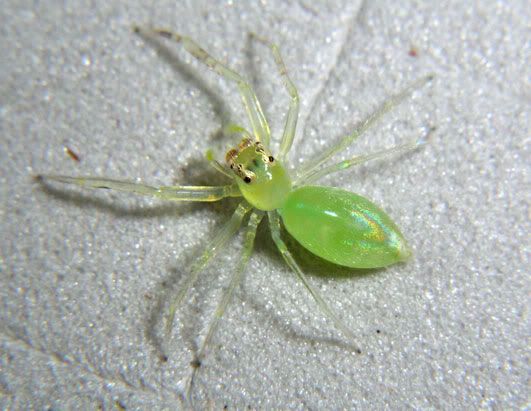 This new jumping spider species, Orthrus sp., was found in a Papua-New Guinea rainforest during the 2008 expedition.
(Conservation International/© Wayne Maddison )
Rabu, 25 Maret 2009
Hungry?
 The Very Hungry Caterpillar Cupcake Party Train by Lyndsay of Coco Cake Cupcakes.
(via The Daily What)
Minggu, 08 Maret 2009
Fly Ear Buds

What's that buzzing in your ears? A fly, you say? It's true--these unique ear buds actually look like flies! Compatible ear buds to most MP3 players, portable gaming systems and laptops will help drown out the outside noise of everyday life. Accessorize your ears! Fly Ear Buds include 2 sets of silicone tips, one small and one large.
At Patina for $12.95
(via J-Walk Blog)
Sabtu, 07 Februari 2009

Jumat, 06 Februari 2009
Bug love
 The diversity of insects on this planet is astonishing and should be a source of continual wonder for us all. It can only be hope that these incredible creatures can be left to survive and continue their species for many millennia to come. Of course they do everything we do - sometimes with much more aplomb!
Langganan:
Postingan (Atom)


